

The Goalbadger's Guide to the ADHD Brain: Why Your "Plan" Isn't Working (Yet)
Your planner is lying to you.
Not on purpose. But every time you write "launch podcast" or "get organized" in those neat little boxes, you're setting yourself up for what I call the Three-Day Fade. You know the one. Day 1: inspired. Day 2: busy. Day 3: that planner's in a drawer under last year's receipts.
Here's what nobody tells you about ADHD brains: The plan isn't the problem. The gap between plan and action is.
And if you've got executive function challenges, whether that's diagnosed ADHD, burnout, or just a brain that refuses to cooperate with traditional productivity systems, you've probably blamed yourself for this gap. You haven't.
Your brain just works differently. And the tools you've been handed? They were built for a brain that isn't yours.
The Executive Function Trap
Let me break this down, recruit.
Executive function is your brain's air traffic controller. It's supposed to:
Take a vague goal and break it into steps
Prioritize those steps in the right order
Remember what you decided yesterday
Initiate action even when you don't feel like it
Switch between tasks without losing the thread
For neurotypical brains, this happens in the background. It's automatic.
For ADHD brains? That air traffic controller is on a coffee break. Or managing twelve runways at once. Or hyper-focused on something completely different.

This is why "just write it down" doesn't work. You can write "start a business" in a planner all day long. But if your brain can't bridge the gap between that phrase and "research LLC filing requirements in my state," you're stuck. Frozen. Scrolling instead of starting.
And then you blame motivation. You blame discipline. You blame yourself.
Stop that. Right now.
Why Traditional Planners Fail ADHD Brains
Most planners are built on a lie: that humans work in straight lines.
You're supposed to:
Set a goal
Make a plan
Execute the plan
Check the box
Feel accomplished
Neat. Linear. Logical.
Except your brain doesn't do linear when executive function is low. Your brain does:
Sideways (starting with step 4 because it seemed interesting)
Spirals (circling back to step 1 three times)
Chaos mode (doing everything except the thing)
Hyperfocus rabbit holes (deep-diving one tiny piece for six hours)
And here's the kicker: None of that is wrong. It's just how you're wired.
The problem is forcing an ADHD brain into a neurotypical system. It's like trying to teach a badger to fly by handing it a map of airports. Doesn't matter how good the map is, you're asking the wrong animal to do the wrong thing.
What you need isn't more structure. It's structure that adapts to how your brain actually works.
Enter the Goal Map (Not Another List)
Forget lists for a second. Lists are static. Your brain is dynamic.
What if instead of a list, you had a map?
A goal map shows you the terrain. It shows you multiple paths to the same destination. It shows you where you are right now, and what's actually within reach today, not some fantasy version of today where you have infinite focus and no distractions.

Here's how it works:
Instead of "launch podcast," a goal map breaks that down into territories:
Equipment & Setup (microphone, recording space, software)
Content Planning (episode topics, format, intro script)
Publishing Infrastructure (hosting platform, RSS feed, distribution)
Launch Preparation (cover art, show notes, first three episodes)
Now here's where it gets interesting for ADHD brains.
You don't have to do these in order. You can start with the territory that feels doable today. Got hyperfocus energy? Dive into equipment research. Brain foggy? Write show notes for a future episode. Distracted but need a win? Design cover art.
The map doesn't care which path you take. It just shows you where each path leads.
That's the difference between a productivity app for ADHD and a regular planner. One adapts. The other judges.
The AI Bridge: From Intention to Action
But even with a map, you've still got one problem: initiation paralysis.
You know where you want to go. You can see the territories. But your brain still can't answer the question: "What do I actually do right now?"
This is where most people spiral. They stare at "Content Planning" and... nothing happens. The gap between the territory and the first action is still too big.
So here's what we built at Goalbadger: an AI that translates your vague goals into concrete, brain-friendly daily actions.
Not "work on podcast." That's useless.
Instead:
"Open Google Docs and write three episode topic ideas you'd actually enjoy talking about"
"Spend 10 minutes comparing Buzz-sprout vs. Anchor pricing, no decision required yet"
"Record 60 seconds of test audio on your phone to hear what your voice sounds like"
See the difference? You don't have to figure out what to do. The AI already did that part.
And for ADHD brains struggling with executive function and memory issues, this is the unlock. The AI becomes your external air traffic controller. It does the breakdown. It does the sequencing. It hands you one clear action.
Your job? Just do that one thing.

Training Mode: From Recruit to Full-Fledged Goalbadger
Here's what I want you to understand, recruit.
You're not broken. Your brain isn't defective. You've just been handed the wrong tools.
An executive function planner that actually works for ADHD doesn't force you into rigid schedules. It maps the territory, shows you options, and meets you where you are today.
Some days you're crushing it. You're hyperfocused, you're in flow, you're knocking out three territories at once.
Other days? You're survival mode. You need something small, something doable, something that doesn't require decision-making.
A good goal map handles both. A good AI handles both.
That's the Goalbadger way. We're training you to work with your brain, not against it. We're building your confidence through small wins that actually stack. And we're giving you the structure that bends instead of breaking when life gets messy.
Because it will get messy. That's not failure. That's Thursday.
Your First Mission
If you're reading this and thinking "okay, but where do I actually start?", good. That's the right question.
Here's your first training exercise:
Pick one goal that's been stuck in your head. The one you keep meaning to start but can't seem to get moving on.
Now answer this:
What's the vaguest part of this goal? (The part where you don't know what "do the thing" actually means)
What's one small territory within that goal you could explore without committing to the whole thing?
What's the smallest possible action you could take in the next 10 minutes, something so small your brain can't say no?
Don't make a plan yet. Don't map it all out. Just identify the gap between your intention and your first action.
That gap? That's where Goalbadger lives. That's where the AI does its best work. That's where traditional planners leave you stranded: and where we're building the bridge.
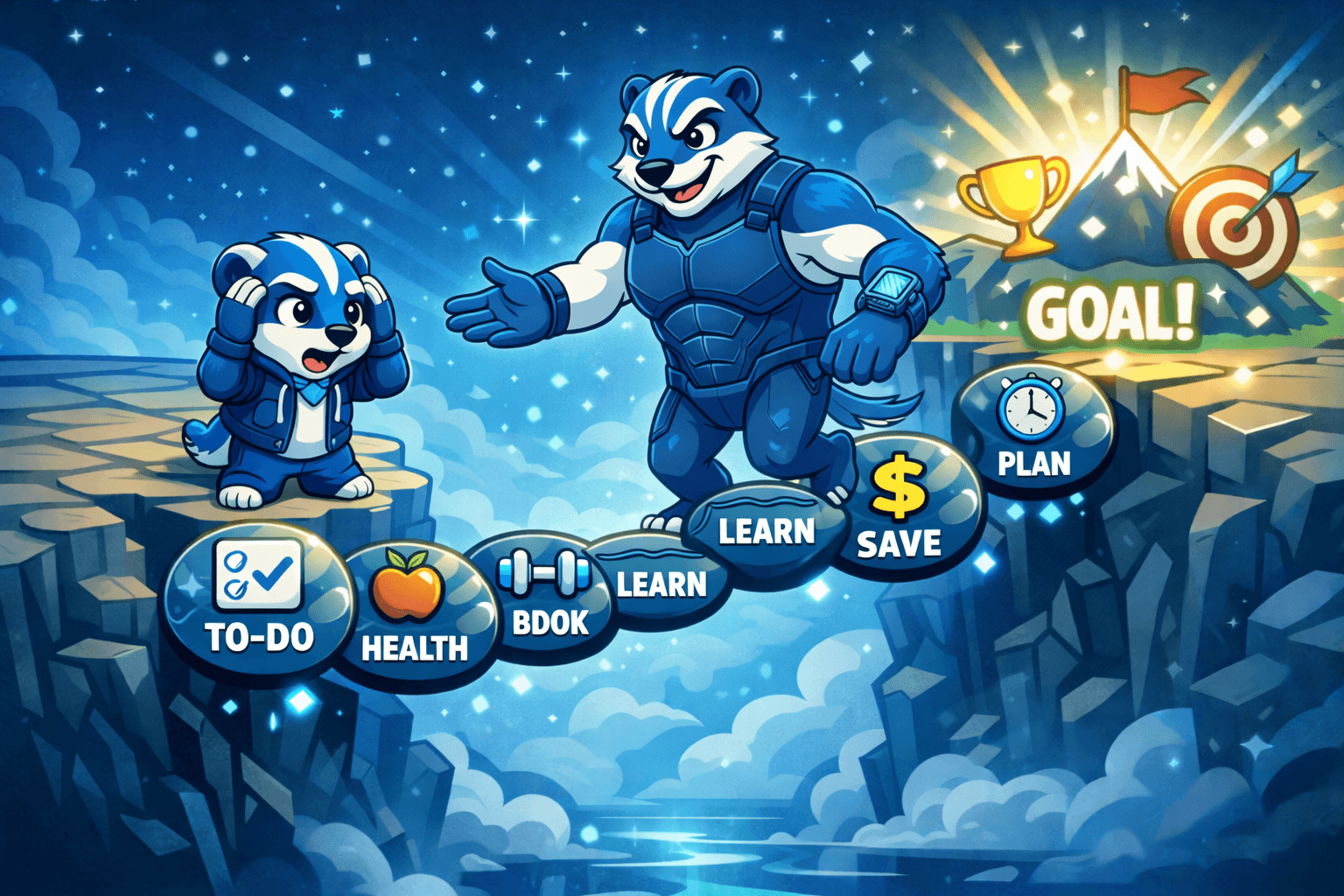
Because here's the truth: you don't need more motivation. You don't need more discipline. You don't need to "try harder."
You need better tools. Tools built for your brain, not someone else's.
And you need a system that treats you like the Goalbadger in training you already are: capable, determined, and just one good structure away from actually finishing what you start.
See how the AI breaks down your goals into daily actions that actually make sense. Or join other Goalbadgers in training who are figuring this out together.
Your move, recruit. Let's turn that stuck goal into your first completed mission.