

Why Your To-Do List is Lying to You: An ADHD Guide to Goal Execution
Your to-do list is a liar.
It knows exactly how to make you feel like a failure before you’ve even finished your first cup of coffee. You wake up with a plan. You write it down. You might even use different colored pens. But by 2:00 PM, you’re staring at the same three bullet points while deep-diving into a Wikipedia rabbit hole about the history of salt.
The list stays the same. The guilt grows.
If you have ADHD, or even just a brain that rebels against traditional structure, you’ve probably blamed yourself for this cycle. You think you lack "discipline." You think you’re "lazy."
You’re wrong.
The problem isn’t you. The problem is that traditional to-do lists are built for neurotypical brains that don't struggle with executive dysfunction. For a Goalbadger, a standard list isn't a tool: it's a trap.
In this guide, we’re going to look at why your current system is failing you and how to build a goal map that actually works with your brain, not against it.
The Executive Function Gap
Standard productivity advice tells you to "just write it down."
But writing it down is only 5% of the battle. For the ADHD brain, the distance between knowing what to do and actually doing it is a massive, yawning chasm. This is known as the executive function gap.
Executive function is like the air traffic controller of your brain. It manages focus, organization, time management, and task initiation. In many of our brains, that controller is perpetually on a coffee break. When you look at a task like "Start a Business" or "Clean the House," your brain doesn't see a task. It sees a giant, blurry blob of overwhelming complexity.
This is why most to-do lists fail. They provide the what, but they completely ignore the how.
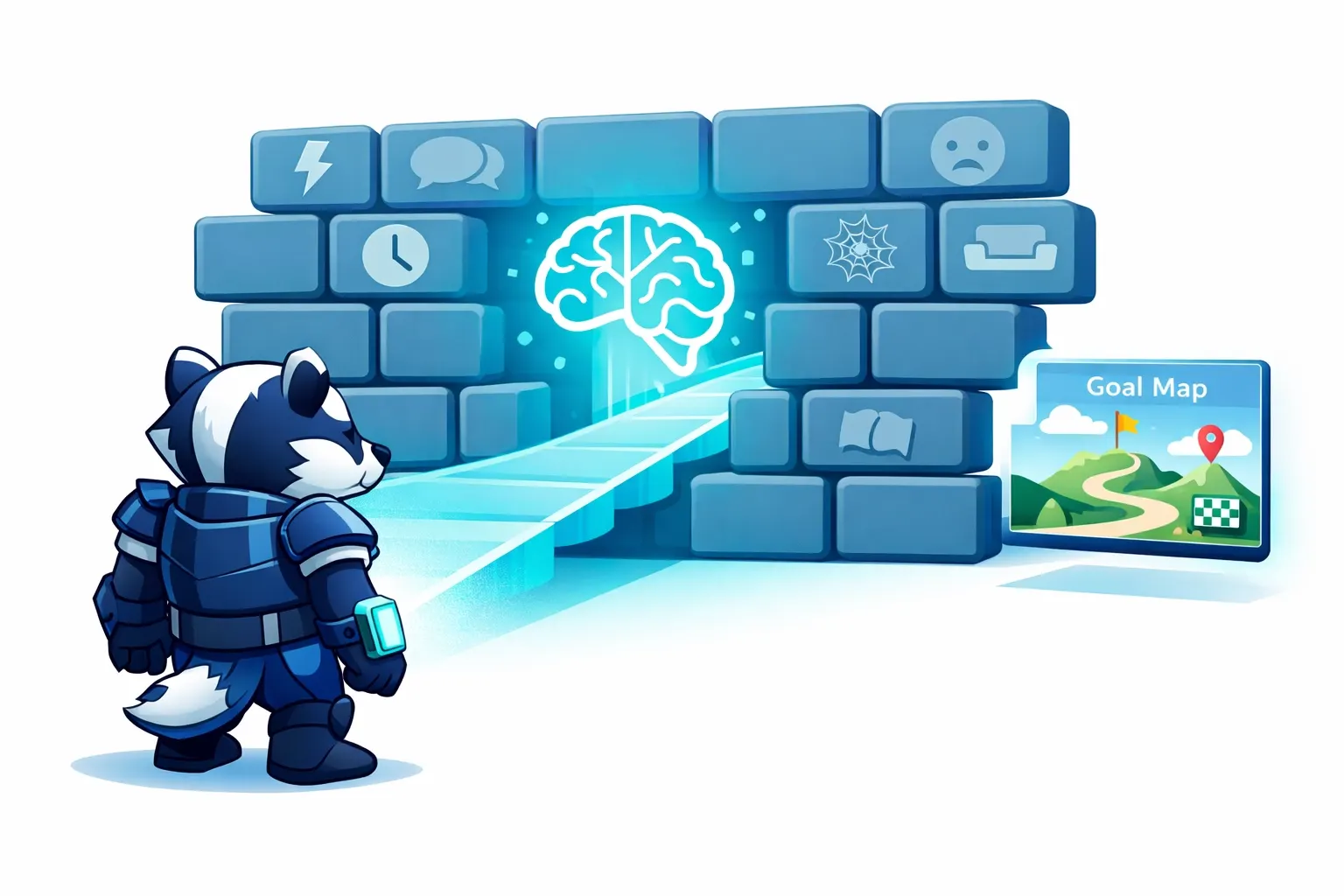
When a task feels too big or too vague, the ADHD brain perceives it as a threat. We experience what’s often called the "Wall of Awful."
Understanding the Wall of Awful
The "Wall of Awful" (a term coined by Brendan Mahan) is the emotional barrier that stands between you and the task you need to complete.
Every time you’ve failed at a task in the past, you’ve added a brick to this wall. The bricks are made of shame, guilt, and the fear of failing again. When you look at your to-do list and see "Finish Project," you aren't just looking at work. You’re looking at that wall.
It’s physically and mentally exhausting to try and climb it every single day. This is why you end up "procrastivity-ing": doing laundry instead of your taxes because the laundry feels like a smaller, less terrifying wall.
To break through, we need more than just a list. We need a productivity app for ADHD that understands how to dismantle the wall brick by brick.
Why Specificity is Your Secret Weapon
Research shows that people who write down their goals are 42% more likely to achieve them. But for us, there’s a catch: the goals have to be almost painfully specific.
A traditional list might say: "Exercise more."
An action plan template for an ADHD brain says: "I will run for 20 minutes on Monday at 6:00 PM."
Why does this work? Because it removes the need for decision-making in the moment. Decisions are a form of "tax" on your executive function. By the time you decide what exercise to do and where to do it, your brain is already tired. You’ve spent your "action juice" on the planning phase.
This is where Goalbadger’s AI Goal Maps come in.
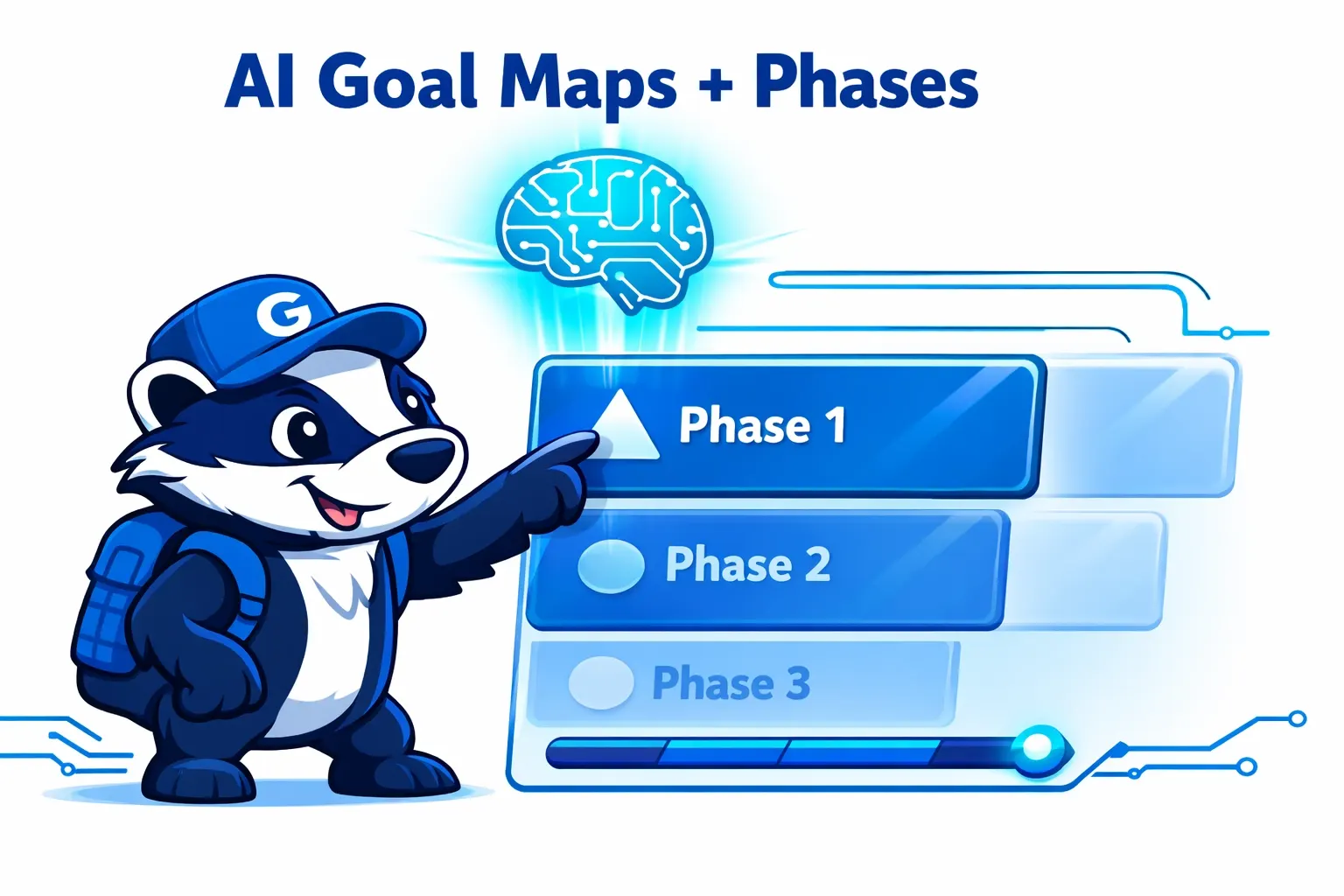
Instead of asking you to figure out the steps, our AI acts as your external prefrontal cortex. It takes your big, scary goal and shatters it into tiny, manageable "Phases."
Breaking the Overwhelm with AI Goal Maps + Phases
If you've ever felt paralyzed by a project, it's because your brain is trying to process the entire outcome at once. You’re looking at the top of the mountain while trying to tie your shoes.
At Goalbadger, we use Phases to hide the mountain.
When you use our goal planning app, the AI generates a sequence. You don't see Step 45 when you're on Step 1. You only see what’s right in front of you.
Phase 1: The Foundation. Small, easy wins to build dopamine.
Phase 2: The Build. The meat of the work, broken into 15-minute tasks.
Phase 3: The Polish. Finishing touches.
By focusing only on the current Phase, you lower the "impossibility and shock factor." It’s no longer a mountain; it’s just a few steps. You can read more about this in our guide to the ADHD brain.
The Dopamine Problem (and the Fix)
ADHD brains are biologically wired to seek dopamine. Traditional tasks are often "dopamine-low." They’re boring, repetitive, or don't offer an immediate reward.
This is why we "chase the shiny."
To win, we have to gamify the process. Checking off a box on a paper list provides a tiny hit of satisfaction, but it’s rarely enough to keep the momentum going for a three-month project.
We need external structure and social rewards. We need to stop trying to be "lone wolves." Truthfully, trying to do it alone is just bad strategy.
Enter the Accountability Clans
One of the most powerful tools for an ADHD brain is body doubling. This is the simple act of working while someone else is around. It provides a "social anchor" that keeps you on task.
But we can't always have a friend sitting on our couch while we answer emails.
That’s why we created Accountability Clans.
In Goalbadger, you aren't just tracking progress in a vacuum. You’re part of a Clan: a small circle of Goalbadgers who are all working on their own missions. When you see others smashing their goals, it triggers your competitive drive and your social reward system.
It’s much harder to ignore a task when you know your Clan is going to see your progress (or lack thereof). This external motivation acts as a bridge during the times when your internal motivation is nowhere to be found.

Task Initiation: The 20-Second Rule
The hardest part of any task for a Goalbadger is the first 20 seconds.
Physics tells us that it takes more energy to start a stationary object moving than it does to keep a moving object in motion. Your brain works the same way. Once you’re in "the zone," you’re golden. But getting into the zone? That’s where the "Wall of Awful" lives.
We recommend a strategy called "Task Previewing."
Before you start your work session, spend exactly 20 seconds looking at your goal map. Don't do any work. Just look at the next step. This "low-effort" entry point signals to your brain that the task isn't a threat.
You can learn more about the science of task initiation here.
Why "Done" is Better Than "Perfect"
Perfectionism is a silent killer for ADHD productivity. Because we struggle with regulation, we often fall into "all or nothing" thinking. If we can't do the task perfectly, we don't want to do it at all.
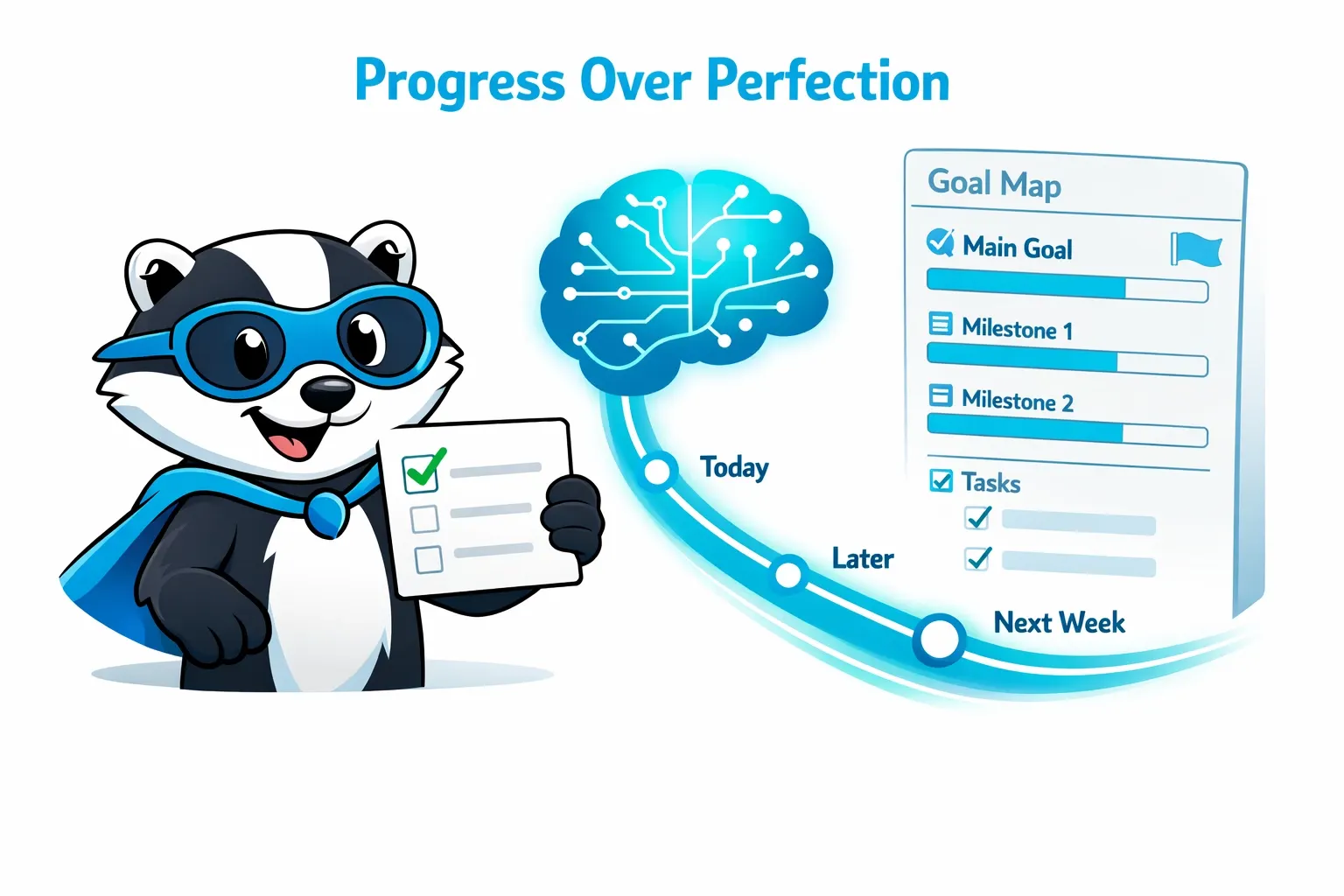
But as a Goalbadger, your mantra needs to be: Progress over Perfection.
An incomplete task on a traditional to-do list looks like a failure. On a Goalbadger Map, an incomplete task is just a data point. Our AI adjusts. We pivot. We move the deadline.
The system is designed to be resilient because we know your focus isn't.
Stop Making Lists. Start Mapping Success.
If you’ve been struggling with your productivity, stop beating yourself up. You haven't been failing; you’ve just been using the wrong operating system for your hardware.
Standard to-do lists are for people who don't have to fight their own brains to get out of bed. You need something more powerful. You need an executive function planner that:
Breaks the Overwhelm: Using AI to create actionable Goal Maps.
Manages the Emotion: Recognizing the Wall of Awful and bypassing it with tiny Phases.
Provides the Heat: Using Accountability Clans to give you the external "push" you need.
You have the drive. You have the ideas. You just need a better map.
It’s time to stop letting your to-do list lie to you. It’s time to join the circle, find your clan, and start crushing your goals like a true Goalbadger.
Ready to build your first real action plan? Start your Goal Map here.